Meeting Minutes Template (Free) + 5 Variations
Most meeting minutes templates fail for the same reason: they were designed for a board meeting and then handed to someone recording a Tuesday standup. Six fields go unfilled, the person stops using it by week three, and the team goes back to a Slack message that says "good chat, will follow up."
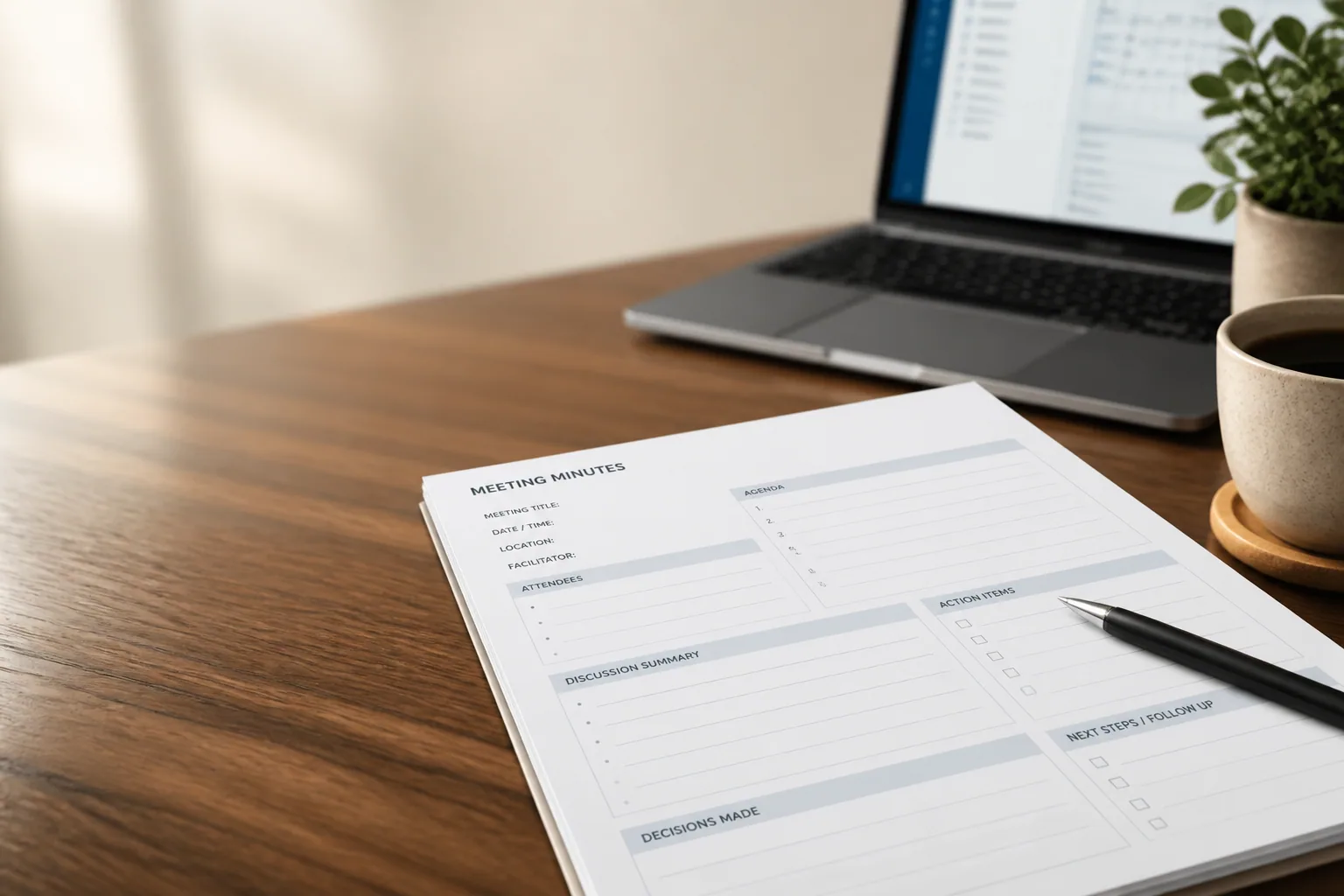
So here are six. One master meeting minutes template that covers any meeting, and five variations shaped to specific jobs — board and nonprofit, weekly standup, project status, client meeting, and a one-page executive summary. Every template is copy-pasteable, and every one is followed by a filled-in example so you can see the format in use rather than guessing what belongs in each blank.
If you want the reasoning behind these choices — what has to be in the record, how to stay neutral, how to record motions properly — that's in how to write meeting minutes. This page is the artifact library.
The six templates
- The master meeting minutes template
- Which template to use when
- Variation 1: board and nonprofit minutes
- Variation 2: weekly team standup
- Variation 3: project status meeting
- Variation 4: client or external meeting
- Variation 5: one-page executive summary
- Formatting rules that keep a template alive
- Frequently asked questions
The master meeting minutes template
This is the default. Six blocks, no field that exists purely for tradition, and a decision line under every agenda item so an item can't be closed without one. Copy it into a doc, save it as your team's template file, and duplicate it per meeting.
Template — master format
[ORGANIZATION / TEAM NAME]
MEETING MINUTES — [Meeting name]
Date: [Day, Month DD, YYYY]
Time: [Start] – [End] [Time zone]
Location: [Room, or video link]
Meeting type: [Regular / Special / Recurring]
Chair: [Name]
Minutes taken by: [Name]
Present: [Names]
Absent: [Names, with reason if relevant]
- [Agenda item]
Context: [One or two sentences — what was presented or considered]
Decision: [What was decided — or "No decision; deferred to (date)"]
- [Agenda item]
Context:
Decision:
- [Agenda item]
Context:
Decision:
Action items
- [Owner] — [Specific task] — due [Date]
- [Owner] — [Specific task] — due [Date]
Next meeting
[Date, time, location] · Carried forward: [Items]
Adjourned: [Time] · Status: DRAFT — pending approval
And filled in, for a cross-functional planning meeting that ran 50 minutes and produced three decisions:
Filled example — master format
ATLAS LOGISTICS
MEETING MINUTES — Q3 Operations Planning
Date: Monday, July 6, 2026
Time: 9:00 – 9:50 a.m. CT
Location: Conference Room B and Microsoft Teams
Meeting type: Recurring (monthly)
Chair: Renata Silva, VP Operations
Minutes taken by: Owen Mbeki
Present: Renata Silva, Owen Mbeki, Hannah Croft, Dmitri Volkov, Aisha Bello
Absent: Paul Nguyen (customer site visit)
- Warehouse 4 throughput
Context: Hannah Croft presented June throughput of 11,400 units per day against a 13,000 target, with 62% of the shortfall traced to the outbound scanning station.
Decision: Add a second scanning station at Warehouse 4, funded from the Q3 equipment contingency.
- Carrier contract renewal
Context: Dmitri Volkov reviewed the Ridgeline Freight renewal terms, including a 6.2% rate increase and an extended claims window.
Decision: Do not renew at the proposed rate. Open a competitive bid with three carriers before the September 30 expiry.
- Seasonal hiring plan
Context: Aisha Bello presented two staffing scenarios for the October peak.
Decision: No decision. Deferred to the August 3 meeting pending the revised demand forecast.
Action items
- Hannah Croft — submit the equipment requisition for the second scanning station — due Fri, July 10
- Dmitri Volkov — issue the carrier RFP to Ridgeline, Northbound, and Cascade Freight — due Fri, July 17
- Aisha Bello — circulate the revised peak demand forecast — due Mon, July 27
- Owen Mbeki — book the August 3 meeting and add the deferred hiring item — due Tue, July 7
Next meeting
Monday, August 3, 2026, 9:00 a.m. CT, Conference Room B · Carried forward: seasonal hiring plan
Adjourned: 9:50 a.m. · Status: DRAFT — pending approval
Tip: the decision line is the whole template. If an agenda item has a context line and an empty decision line, that item did not finish. Write "No decision; deferred to [date]" and put the deferral on the next agenda before you close the doc.
Teams that adopt this one habit notice something uncomfortable within a month: a lot of recurring agenda items have never produced a decision. That's not a note-taking problem, and finding it is the point.
Which template to use when
Pick by what the meeting produces, not by how important it feels.
| Template | Use it for | Length | Records motions & votes? | Needs formal approval? |
|---|---|---|---|---|
| Master | Any meeting that produces decisions and owners | 1–2 pages | No | No |
| Board / nonprofit | Board, committee, HOA, association meetings | 2–3 pages | Yes — exact wording and counts | Yes, at the next meeting |
| Weekly standup | Daily or weekly team sync, 15–30 min | Half a page | No | No |
| Project status | Recurring project checkpoints with a steering group | 1–2 pages | No | Sponsor sign-off, not a vote |
| Client / external | Client calls, vendor meetings, partner reviews | 1 page | No | Client confirms by reply |
| Executive summary | Anything a busy stakeholder needs in 60 seconds | 1 page, hard limit | No | No |
Variation 1: board and nonprofit minutes
This is the one with legal weight. It adds quorum confirmation, approval of the previous minutes, motions with exact wording, vote results, and a signature block. Under Robert's Rules of Order Newly Revised (12th edition) you record the name of whoever made a motion but not the seconder, and individual names appear in the vote only for a roll call or a recorded dissent.
Template — board / nonprofit minutes
[ORGANIZATION NAME]
MINUTES OF THE [REGULAR / SPECIAL] MEETING OF THE BOARD OF DIRECTORS
[Day, Month DD, YYYY] · [Location, and video conference if applicable]
Call to order
The meeting was called to order at [time] by [Chair name]. [Name] recorded the minutes.
Directors present: [Names, with join times if late]
Directors absent: [Names]
Also present: [Staff, counsel, guests]
Quorum: A quorum was present ([X] of [Y] directors required).
- Approval of previous minutes
The minutes of the [date] meeting were approved [as distributed / as corrected, the correction being ___].
- Officer and staff reports
[Name, title] presented [subject]. The report was [filed for audit / received].
- [Business item]
Conflict disclosure: [Name] disclosed [interest], recused, and left the room at [time].
Motion: [Name] moved "[exact wording of the motion]."
Amendment: [Name] moved to amend by [striking / inserting ___]. The amendment [carried / failed].
Vote: [Voice vote — the motion was adopted / failed] OR [Roll call — Aye: ___. No: ___. Abstain: ___. Recused: ___.]
Result: The motion was [adopted / lost], [count]–[count].
- Executive session
The Board entered executive session at [time] to discuss [general subject] and returned to open session at [time]. [No action was taken / Action taken is recorded in the executive session minutes].
- Notices and announcements
The next regular meeting will be held [date, time, location].
Adjournment
There being no further business, the meeting was adjourned at [time].
Respectfully submitted,
[Name], Secretary
Approved by the Board on [date].
Filled example — board minutes
HARBORVIEW YOUTH SAILING ASSOCIATION
MINUTES OF THE REGULAR MEETING OF THE BOARD OF DIRECTORS
Wednesday, May 13, 2026 · Harborview Boathouse, 9 Pier Road, and by video conference
Call to order
The meeting was called to order at 7:02 p.m. by Chair Marisol Duarte. Secretary Kwame Osei recorded the minutes.
Directors present: Marisol Duarte (Chair), Kwame Osei (Secretary), Bette Halloran (Treasurer), Jonah Reyes, Ingrid Lassiter, Tom Whitaker (joined 7:11 p.m.).
Directors absent: Cheryl Ndlovu.
Also present: Program Director Alina Petrov.
Quorum: A quorum was present (four of seven directors required).
- Approval of previous minutes
The minutes of the April 8, 2026 meeting were approved as distributed.
- Treasurer's report
Treasurer Bette Halloran presented financial statements for the period ending April 30, 2026, showing unrestricted reserves of $128,400. The report was filed for audit.
- FY2027 operating budget
Motion: Jonah Reyes moved "that the Board adopt the FY2027 operating budget of $612,000 as presented, with the equipment line increased to $48,000."
The Board discussed the equipment increase and the impact on the scholarship reserve.
Vote: Counted vote — 5 in favor, 1 opposed, 1 abstaining.
Result: The motion was adopted, 5–1.
- Dock repair contract
Conflict disclosure: Director Ingrid Lassiter disclosed that her brother-in-law is a partner at Cove Marine Contractors, one of the three bidders. She recused herself and left the room at 7:38 p.m.
Motion: Marisol Duarte moved "that the Board award the north dock repair contract to Seabright Marine in the amount of $74,500."
Vote: Roll call — Aye: Duarte, Halloran, Osei, Reyes, Whitaker. No: none. Recused: Lassiter. Absent: Ndlovu.
Result: The motion was adopted, 5–0. Ms. Lassiter returned at 7:49 p.m.
- Notices
The next regular meeting will be held Wednesday, June 10, 2026 at 7:00 p.m.
Adjournment
There being no further business, the meeting was adjourned at 8:14 p.m.
Respectfully submitted,
Kwame Osei, Secretary
Approved by the Board on June 10, 2026.
Not legal advice. What a board is required to record varies by jurisdiction, entity type, and your own bylaws — a Delaware corporation, a 501(c)(3), and a homeowners association all operate under different rules. Most US states require corporations and nonprofit corporations to keep written minutes of board meetings, and courts have treated missing minutes as evidence that an organization failed to observe corporate formalities. Check your bylaws and your state code, and ask counsel when it matters.
Variation 2: weekly team standup
Fifteen minutes doesn't justify two pages. This version drops everything except what changed, what's stuck, and what got decided. If nothing was decided and nothing is blocked, the whole record is four lines, and that's a success.
Template — weekly standup
[TEAM] STANDUP — [Date] · [Time] · [Channel or room]
Present: [Names] · Absent: [Names]
Updates
- [Name] — shipped: [] · next: [] · blocked by: [___ or none]
- [Name] — shipped: [] · next: [] · blocked by: [___ or none]
Decisions
- [Decision, or "None this week"]
Blockers needing escalation
- [Blocker] → escalated to [Name] by [Date]
Actions
- [Owner] — [Task] — due [Date]
Filled example — weekly standup
PLATFORM ENGINEERING STANDUP — Monday, July 20, 2026 · 9:15 a.m. ET · #platform-standup
Present: Ravi Menon, Claire Osborne, Yusuf Adeyemi, Lena Fischer · Absent: none
Updates
- Ravi — shipped: auth token rotation to staging · next: production rollout Wed · blocked by: none
- Claire — shipped: nothing (on-call, 3 P2 incidents) · next: resume search indexing work · blocked by: none
- Yusuf — shipped: 40% of the queue migration · next: finish consumer cutover · blocked by: waiting on the DBA read replica
- Lena — shipped: load test harness · next: baseline run against staging · blocked by: none
Decisions
- Push the queue migration cutover from Thursday to the following Tuesday. Two incidents last week consumed the buffer.
Blockers needing escalation
- DBA read replica not provisioned (5 days open) → escalated to Marta Kern, Infrastructure, by Tue, July 21
Actions
- Ravi — announce the Wednesday auth rollout window in #eng-announcements — due Mon, July 20
- Yusuf — email Marta re: read replica, cc Ravi — due Tue, July 21
- Claire — update the migration date on the roadmap board — due Mon, July 20
Variation 3: project status meeting
Status meetings drift into narration, so this template forces a position: a status colour, planned dates against actual dates, and risks with a named owner. The point isn't a pretty report — it's that "amber" has to be justified in writing by someone whose name is on it.
Template — project status meeting
[PROJECT NAME] — STATUS REVIEW
Date: [] · Time: [] · Phase: [] · Report period: []
Chair: [] · Minutes: [] · Present: [] · Absent: []
Overall status
[Green / Amber / Red] — [One sentence justifying the colour]
Change since last review: [Improved / Unchanged / Worsened]
Milestones
- [Milestone] — planned [date] — forecast [date] — [On track / At risk / Slipped]
Budget and scope
Spent to date: [] of [] · Scope changes this period: [___]
Risks and issues
- [Risk or issue] — impact [High/Med/Low] — owner [Name] — mitigation [___] — review by [date]
Decisions
- [Decision, and who approved it]
Actions
- [Owner] — [Task] — due [Date]
Next checkpoint
[Date, time] · Decisions required at that checkpoint: [___]
Filled example — project status meeting
MERIDIAN ERP MIGRATION — STATUS REVIEW
Date: Thursday, July 16, 2026 · Time: 2:00 – 2:45 p.m. GMT · Phase: 3 of 5 (data migration) · Report period: July 1–15
Chair: Dev Chaudhary (Programme Director) · Minutes: Sophie Renard · Present: Dev Chaudhary, Sophie Renard, Ana Duarte, Michael Boyle, Fenna de Vries · Absent: Tariq Hassan (annual leave)
Overall status
Amber — data cleansing for the supplier master is 3 weeks behind and now sits on the critical path.
Change since last review: Worsened (was Green on July 2).
Milestones
- Supplier master cleansed — planned Jul 31 — forecast Aug 21 — Slipped
- Finance module UAT start — planned Aug 17 — forecast Aug 17 — At risk
- Go-live wave 1 — planned Oct 5 — forecast Oct 5 — On track
Budget and scope
Spent to date: £1.42M of £2.10M · Scope changes this period: one — multi-currency reporting moved to wave 2 at the sponsor's request.
Risks and issues
- Supplier records with missing tax IDs (11,200 of 38,000) — impact High — owner Ana Duarte — mitigation: two contractors added to the cleansing team from July 20 — review by Jul 30
- UAT tester availability collides with month-end close — impact Medium — owner Michael Boyle — mitigation: agreed a two-week UAT window starting Aug 24 with Finance — review by Aug 7
Decisions
- Approve two additional data contractors for six weeks (approx. £34,000), approved by sponsor Fenna de Vries.
- Hold the October 5 go-live date. Wave 1 scope will be reduced before the date moves.
Actions
- Ana Duarte — onboard both contractors and republish the cleansing plan — due Mon, July 20
- Michael Boyle — confirm the revised UAT window with Finance in writing — due Fri, July 24
- Sophie Renard — update the risk register and circulate to the steering group — due Fri, July 17
Next checkpoint
Thursday, July 30, 2026, 2:00 p.m. GMT · Decisions required: whether to reduce wave 1 scope.
Tip: separate decisions from actions, always. They get merged constantly and they're different objects. A decision is a settled question that stays settled ("hold the October go-live"). An action is a task with an owner and a date ("onboard both contractors by July 20").
Merging them is how a decision quietly becomes optional — it ends up in a task list, gets marked done, and six weeks later nobody can point to where it was agreed.
Variation 4: client or external meeting
External minutes have a second job: they're a shared record you're going to send to someone outside your company, so they double as a confirmation email. Write commitments in both directions explicitly, and keep anything internal out of the document entirely — no pricing strategy, no assessment of the client, nothing you wouldn't want forwarded.
Template — client / external meeting
MEETING SUMMARY — [Client name] & [Your company]
Date: [] · Time: [] · Format: [Call / video / on site]
[Client] attendees: [Name, title] · [Your company] attendees: [Name, title]
Purpose: [One line]
What we discussed
- [Topic] — [outcome in one line]
Client priorities and requirements stated
- [Requirement, in the client's own framing]
Open questions
- [Question] — to be answered by [Name] by [Date]
Our commitments
- [Your company] will [___] by [Date] — owner [Name]
Client commitments
- [Client] will [___] by [Date] — owner [Name]
Next step
[Meeting or milestone, with date] — [who schedules it]
Note: Please reply with any corrections by [date]. Absent corrections, this stands as the shared record.
Filled example — client meeting
MEETING SUMMARY — Northwind Retail & Kestrel Systems
Date: Tuesday, July 14, 2026 · Time: 11:00 – 11:45 a.m. ET · Format: Zoom
Northwind attendees: Carla Jennings (Director of IT), Sam Okafor (Store Ops Manager)
Kestrel attendees: Elena Vasquez (Account Director), Ben Hart (Solutions Engineer)
Purpose: Scope the pilot for in-store inventory scanning across 12 locations.
What we discussed
- Pilot footprint — agreed on 12 stores across two regions rather than the 30 originally proposed.
- Integration — Northwind uses SAP with a custom middleware layer; Ben confirmed the standard connector needs a mapping change, not a rebuild.
- Timeline — a September start is achievable if hardware is ordered by August 8.
Northwind priorities stated
- Cycle count time must drop by at least 40% or the pilot won't be extended.
- Store staff training must fit in a single 30-minute shift briefing.
- No change to the existing SAP upgrade schedule in Q4.
Open questions
- Whether the middleware team can support the mapping change in August — Carla Jennings to confirm by Fri, July 24.
- Handheld model: rugged vs standard — Ben Hart to send a cost and durability comparison by Fri, July 18.
Kestrel commitments
- Kestrel will send a revised 12-store pilot proposal with pricing by Fri, July 24 — owner Elena Vasquez.
- Kestrel will provide the handheld comparison and a draft training outline by Fri, July 18 — owner Ben Hart.
Northwind commitments
- Northwind will confirm middleware team availability by Fri, July 24 — owner Carla Jennings.
- Northwind will nominate the 12 pilot stores by Fri, July 31 — owner Sam Okafor.
Next step
Proposal review call, Tuesday, July 28, 11:00 a.m. ET — Elena Vasquez to send the invite.
Note: Please reply with any corrections by Thursday, July 16. Absent corrections, this stands as the shared record.
Variation 5: the one-page executive summary
Written for the person who wasn't in the room and has sixty seconds. Hard limits: three decisions, three actions, one risk, one ask. If there were more than three decisions, the extras go in the full minutes and this document links to them. The constraint is the feature — the discipline of choosing what matters is exactly what makes the summary readable.
Template — one-page executive summary
[MEETING NAME] — EXECUTIVE SUMMARY
[Date] · [Attendee count] attendees · Full minutes: [link]
In one line
[What this meeting was for and what it produced.]
Decisions (max 3)
- [Decision] — [who approved it]
Actions (max 3)
- [Owner] — [Task] — due [Date]
Top risk
[Risk] — owner [Name] — [what happens if it isn't handled]
What we need from you
[The specific ask, with a date — or "Nothing; for information only."]
Next checkpoint
[Date] — [what will be decided then]
Filled example — executive summary
MERIDIAN ERP MIGRATION — EXECUTIVE SUMMARY
July 16, 2026 · 5 attendees · Full minutes: /projects/meridian/minutes-2026-07-16
In one line
Phase 3 status review: data cleansing has slipped three weeks and the programme moved from Green to Amber, but the October go-live date holds.
Decisions
- Add two data contractors for six weeks, approx. £34,000 — approved by Fenna de Vries.
- Hold the October 5 go-live. Wave 1 scope will be reduced before the date moves.
- Move multi-currency reporting to wave 2 — requested by the sponsor.
Actions
- Ana Duarte — onboard contractors, republish the cleansing plan — due Mon, July 20
- Michael Boyle — confirm the revised UAT window with Finance — due Fri, July 24
- Sophie Renard — update the risk register — due Fri, July 17
Top risk
11,200 supplier records are missing tax IDs — owner Ana Duarte. If they aren't cleansed by August 21, finance UAT can't start on time and wave 1 scope has to be cut.
What we need from you
Countersign the £34,000 contractor spend by Friday, July 24.
Next checkpoint
July 30 — decision on whether to reduce wave 1 scope.
Formatting rules that keep a template alive
A template dies from friction, not from being wrong. Five rules keep it in use.
Use the same field order every time. The value of a standard meeting minutes format is that a reader knows where to look — decisions are always in the same place, actions are always at the bottom. Rearranging by meeting destroys that.
Keep it in plain text or a plain doc. Fancy tables break when someone pastes them into email. A monospaced or plainly-structured document survives copy-paste into Slack, Notion, Confluence, Word, and a CMS, which is the actual test.
Fill the header before the meeting starts. Date, attendees, agenda items as empty headings. You'll spend the meeting filling in blanks instead of building structure while people are talking.
Never ship a doc with an empty decision line. Write "No decision; deferred to [date]" — the honest version — and carry it forward.
Send it the same day. Minutes that arrive Thursday for a Monday meeting get corrected by nobody, because nobody remembers well enough to correct them.
That last rule is where most teams break, and it's a memory problem more than a discipline problem. If the meeting is recorded and transcribed, which is exactly what an AI meeting note-taker does, the header and the raw material are already there when you sit down to write, so the job becomes editing rather than reconstruction. Laxis handles that end for Zoom, Google Meet, and Teams — recording, transcribing in 100+ languages, and pulling out action items with owners attached, on a free plan that includes 300 transcription minutes a month. The honest limit is worth stating plainly: what comes back is a fast, accurate first draft that fills the template, and a person still has to make the judgment calls — the neutral phrasing, the decision wording, and above all what to cut. A verbatim transcript is the wrong thing to file as your official minutes, no matter how good the transcription is.
Fill the template automatically, then edit it
Laxis records and transcribes your Zoom, Google Meet, and Teams meetings and extracts action items with owners attached — so the first draft of your minutes is written before you open the doc. Free plan includes 300 transcription minutes a month.
The bottom line
A template is a set of questions the format refuses to let you skip. The master version asks what was decided. The board version asks who moved it and how the vote went. The client version asks what each side committed to. The executive version asks what the three things are that a busy person needs.
Pick the one that matches what your meeting actually produces, keep it in the same order every time, and send it the same day. If you want the craft behind the format — neutral phrasing, what to leave out, how motions are recorded, how long to keep the file — that's in how to write meeting minutes.
Frequently asked questions
What should a meeting minutes template include?
A usable meeting minutes template has six blocks: a header with the meeting name, date, time, and location; attendance including who was absent; one section per agenda item with a decision line; an action item list with owners and due dates; the next meeting details; and a status line marking the document as draft or approved. Formal bodies add quorum, motions, and votes.
What is the standard meeting minutes format?
The standard format runs header, attendance, agenda items in order, action items, next meeting, adjournment. Each agenda item gets a short line of context followed by an explicit decision. Formal minutes insert quorum confirmation and approval of the previous minutes near the top, and record motions with their exact wording and vote results inside the relevant item.
What goes in a board meeting minutes template that isn't in a regular one?
Five extra elements: confirmation that a quorum was present, approval of the previous minutes, the exact wording of every motion with the name of who moved it, the vote result with counts, and a signature block for the secretary plus the approval date. Conflict-of-interest recusals and any move in and out of executive session also belong in board minutes.
How long should meeting minutes be?
One to three pages for most meetings, and a single page for a routine standup. Length should track the number of decisions, not the length of the meeting. A two-hour board meeting that produced three motions makes shorter minutes than a 45-minute planning session that produced eleven action items, and that is the correct outcome.
Do informal team meetings need minutes?
They do not need formal minutes, but they benefit from a short decision and action record. Nobody needs quorum language for a Tuesday standup. What they do need is a written line for every decision and every commitment, because the cost of an undocumented decision is the same whether the meeting was formal or not.
Can an AI tool fill in a meeting minutes template for you?
It can produce the first draft, not the final record. Tools like Laxis transcribe the call and pull out decisions and action items with owners, which fills most of the template automatically. A person still has to edit for tone, judgment, and what to leave out, and a raw transcript should never be filed as the official minutes.